
The Markings of Time: Exploring the Precision, Regulation, and Testing of Mechanical Watches
In an age dominated by smartphones, the timekeeping function of a watch may seem less critical. However, for enthusiasts, watchmakers, and collectors of mechanical timepieces, precision remains the core metric for measuring a watch’s soul and craftsmanship. It is not merely a physical symphony of gears and springs but a precise dance against the intangible flow of time.
I. What is “Precision”? Understanding the Timepiece’s Heartbeat
Watch precision is typically expressed as “daily rate” or “daily deviation,” meaning the gain or loss in seconds per 24 hours. Yet, the standards are not absolute:
- Chronometer Certification (COSC): The Contrôle Officiel Suisse des Chronomètres certification requires movements to be tested in five positions and at three temperatures, with an average daily rate between -4 and +6 seconds. This is the accuracy threshold for high-volume, premium movements.
- Top-Tier Certification: Standards are even stricter for certifications like Rolex’s Superlative Chronometer (±2 seconds/day) or the Patek Philippe Seal (-3/+2 seconds/day).
- Real-World Wear: It’s important to note that laboratory data can differ from performance on the wrist. The wearer’s activity level, the watch’s resting position overnight, ambient magnetic fields, and temperature all affect timekeeping.
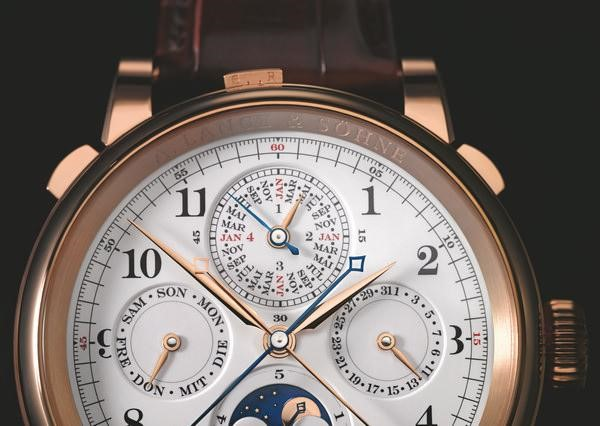
II. The Regulation of the Soul: The Watchmaker’s Touch of Magic
Even the finest movements require meticulous adjustment after assembly to achieve optimal performance. This highly skilled process, reliant on experience and feel, is known as the “art of precision regulation”.
Key Components for Regulation:
- Balance Wheel and Hairspring: This is the “heart” and “soul” of the movement. Their isochronism (the consistency of period across different amplitudes) is fundamental to accuracy.
- Regulator and Free-Sprung Balance:
-
Regulator (Index): The traditional method, adjusting the effective length of the hairspring by moving the regulator.
-
-
-
Free-Sprung Balance (common in modern high-end movements): Eliminates the regulator. Precision is achieved by adjusting the inertia of the balance wheel via “inertia blocks” or “timing screws” located on its rim, allowing for more stable and fine-tuned regulation.
-
Key Dimensions of Regulation:
- Positional Error Adjustment: A movement will run at different rates in various positions (dial up, dial down, crown up, etc.) due to gravity’s effect on the balance and hairspring. The watchmaker must test and balance these positions to minimize positional error.
- Isochronism Adjustment: Ensures stable timekeeping whether the mainspring is fully wound or nearly depleted, despite changes in the balance wheel’s amplitude.
- Temperature Compensation: Metals expand and contract with temperature, affecting the hairspring’s elasticity. High-end movements use special alloys (like Nivarox hairsprings) or complex bimetallic cut balance wheels to compensate for temperature-induced error.
III. The Scientific Verdict: How Precision Testers Listen to the Heartbeat of Time
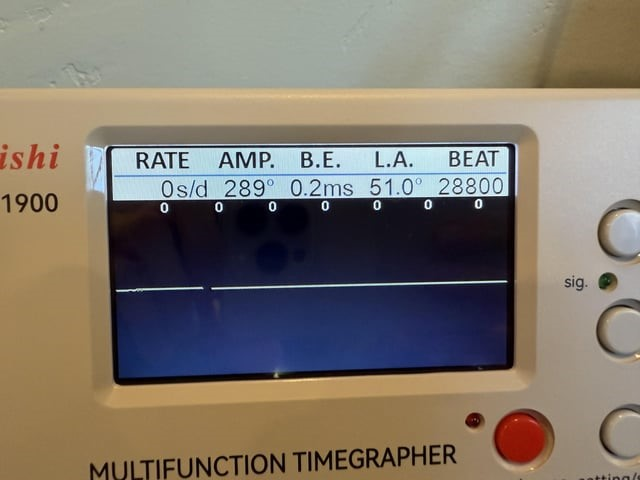
Modern watchmaking no longer relies solely on the seasoned ear of a master. Professional “acoustic timing machines” or “watch rate analyzers” have become the indispensable “eyes” and “ears” of the watchmaker.
How They Work: A microphone on the machine picks up the “tick-tock” sound of the running movement, converts it into a soundwave graph, and precisely calculates the interval between consecutive ticks. This allows for real-time calculation of key parameters like daily rate, amplitude, and beat error.
Interpreting the Data:
- Rate Curve: Visually displays the gain/loss.
- Amplitude: Ideal amplitude is typically between 250° and 310°. Too low may indicate insufficient power; too high may cause “knocking.”
- Beat Error: Indicates the evenness of the beat. A flat line is the ideal state.
- Sound Diagram: Can reveal subtle flaws like gear train friction or escapement knocking.
Testing is usually conducted in multiple positions and simulated power states to create a complete “performance map” of the movement.
IV. The Ultimate Test: From Laboratory to Wrist
A perfectly regulated watch must still undergo rigorous dynamic simulation testing and real-world wear testing.
- Six-Position Testing: Long-duration timekeeping records in fixed laboratory positions.
- Magnetization Test: Exposing the watch to strong magnetic fields to test its resistance.
- Simulated Wear Testing: Using a rotor or gyroscopic machine to simulate daily arm movement, testing stability under different dynamics.
- Real-World Wear Observation: Many top-tier brands require watchmakers or testers to wear the watch for several weeks, recording data in real-life scenarios for final fine-tuning.
Conclusion: Between Precision and Poetry
The pursuit of ultimate precision is a technological manifestation of humanity’s attempt to master time. Yet, the charm of a mechanical watch lies precisely in its nature as a “living machine.” Slight, reasonable deviations become its unique “personality” and “breath”.
When we understand the complex regulation and testing behind a wristwatch, we appreciate not only the marvel of split-second accuracy but also the dedication and romance of humanity’s patient, intelligent, and passionate struggle against the laws of physics, sculpting the sands of time within a tiny space. This pursuit, blending science, art, and philosophy, is the eternal core value of fine mechanical watchmaking.
 English
  French
  German
  Italian